The Hidden Brain-Chemistry Issue That May Be Behind Your Child's Meltdowns, Focus Struggles, and Emotional Overwhelm!
Here's what almost no one tells you:
It might not be about parenting at all.
Inside your child's brain are chemical messengers, including serotonin and dopamine, that help them stay calm, focused and emotionally steady. Think of them as the volume knob for big feelings and the steering wheel for attention.
When that balance dips, even a loving, patient, consistent household can feel like a daily battle. And everything you have been doing to help may be missing the real root of it.
What is brain-chemistry balance (and why haven't you heard about it)?
You do not need to remember the long names. Here is what matters.
Serotonin and dopamine are two of the brain's main chemical messengers. They help with:
- Mood and emotional control
- Focus and attention
- Stress response
- Feeling calm and settled
A child's brain is still being built. Sleep, stress, growth spurts, food and genes all push those chemicals up and down. When they run low or out of balance, the signals get noisy: small things feel huge, and getting back to calm takes forever.
It is not a character flaw. It is not manipulation. It is a brain that is working harder than it should to feel okay.
Is this what is happening with your child? Here is what it looks like
You cannot see brain chemistry, but you can see how it shows up every single day.
Big feelings out of nowhere
Fine one minute, a full meltdown the next, over something small. Their nervous system is genuinely overwhelmed.
Trouble focusing or finishing tasks
They start homework with good intentions, then drift. Every distraction wins.
Sensory overload
Shirt tags, loud rooms, bright lights. Things that do not bother other kids send them over the edge.
Slow to calm down
You have tried deep breaths, hugs and walking away, and it still takes forever to bring them back.
Constant worry
The "what if" questions, and a mind that will not switch off at bedtime.
If you are nodding along, you are not alone. And more importantly, this is not your fault, and it is not your child's fault either.
It is biology.
5 things every parent should know about brain chemistry and their child
1. This is not rare. It is just rarely talked about
Most parents hear a lot about behavior charts and screen time, and very little about what is going on in the brain underneath. Your pediatrician may not have brought it up. The school may not know. Family members may call it "just a phase."
But if your child's chemistry is out of balance, it shows up every single day until that is addressed.
2. You cannot discipline your way out of a chemistry issue
When your child has a meltdown, it is not defiance and it is not attention-seeking. Their brain does not have what it needs to steady itself in that moment.
You would not tell a child with low blood sugar to "just focus harder" on a math test. Consequences, timeouts and stern talks cannot fix something happening inside the brain.
3. Routines help behavior. They do not touch chemistry
Sleep, structure, and good food all matter, and you should keep them. But a sticker chart does not change how the brain balances its messengers. That is why so many parents do everything right and still feel stuck.
4. When the brain gets support, everything gets easier
Imagine your child being able to:
- Move between activities without a meltdown
- Sit through dinner without getting overstimulated
- Handle disappointment without falling apart
- Do homework without the nightly battle
- Enjoy being with friends instead of dreading it
You are not changing who they are. You are giving their brain support so they can feel like themselves.
5. You do not have to choose between "nothing" and medication
There is an ingredient researchers have now tested in children, and almost nobody in the United States has heard of it. It is saffron.
Saffron is the red thread pulled by hand from the Crocus sativus flower, three threads to a flower, which is why it is the most expensive spice in the world. What is new is that scientists are testing it in kids, with placebo groups and double-blind rules, like a medicine.
A 2026 review of culinary spices lists regulation of monoaminergic neurotransmitters, the family that includes serotonin and dopamine, among the ways saffron appears to work. That research is mostly in adults, so we are telling you what scientists are studying, not promising a result.
One trial put saffron head to head with methylphenidate, the drug in Ritalin. The two groups did not differ.
Trial 1: saffron versus methylphenidate in children with ADHD
In 2019, a team at Tehran University published a six-week, randomized, double-blind study in the Journal of Child and Adolescent Psychopharmacology.
54 children, ages 6 to 17, all with a diagnosis of ADHD, were randomly given either methylphenidate or saffron capsules. The saffron dose was 20 mg a day under 30 kg and 30 mg a day over 30 kg.
Parents and teachers rated symptoms at the start, at week 3 and at week 6. The saffron group and the methylphenidate group did not differ significantly on either the parent or the teacher scores, and side effects were similar. The authors concluded that short-term saffron showed the same efficacy, and that larger studies over longer periods are needed.
That last sentence matters. This was a pilot, with 54 children and six weeks. It does not prove saffron works for every child, and it does not mean a bottle of drops replaces a prescription.
Trial 2: saffron in teenagers with anxious and low mood
In 2018, researchers in Australia ran an eight-week, randomized, double-blind, placebo-controlled trial in the Journal of Affective Disorders. 80 teenagers, ages 12 to 16, with mild to moderate anxiety or low-mood symptoms took a placebo or a standardized saffron extract. 68 finished.
On the teenagers' own reports, total anxiety and low-mood scores dropped by an average of 33% in the saffron group, against 17% on placebo. The extract was well tolerated. The honest part: the parents' reports were less consistent, and the authors said so.
Introducing AVENIA Saffron RX
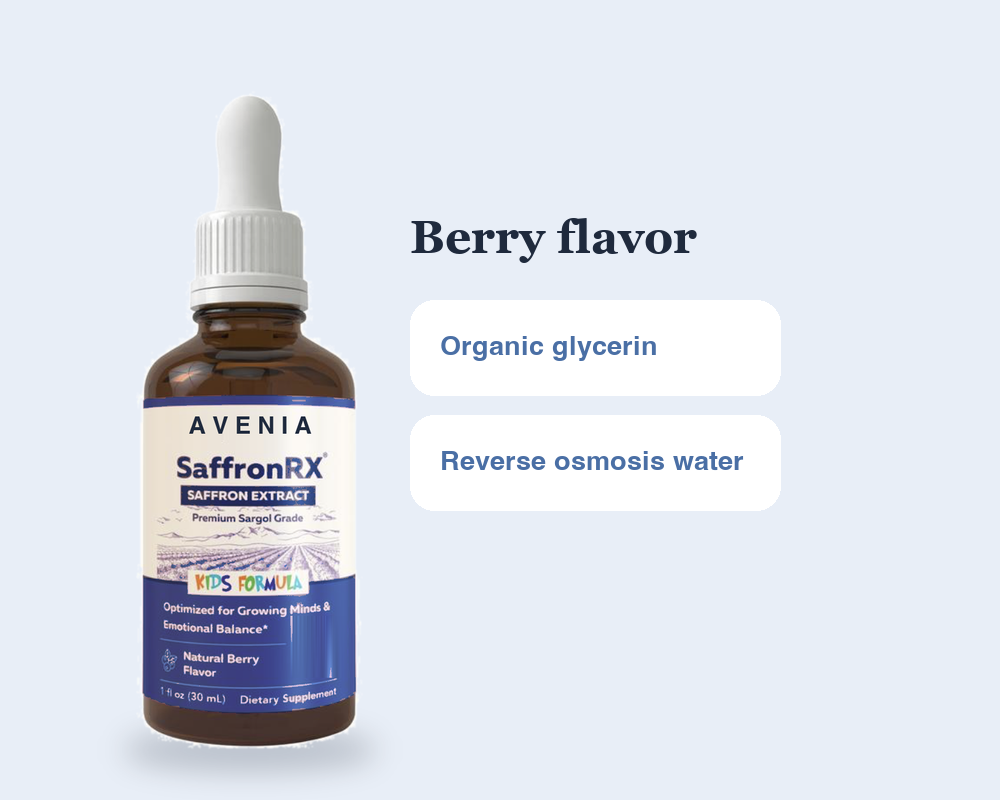
AVENIA Saffron RX is not a stimulant, and it is not a prescription drug. It is organic saffron extract in berry-flavored drops for kids ages 3 to 17, dosed by age on the label.
The label lists Saffr'Activ Organic Saffron Extract (Sargol grade), organic vegetable glycerin, reverse osmosis water and organic berry flavor. Nothing else to read.
One note we owe you: the trials above used their own saffron products, not ours. We are telling you what the research looked at, not claiming our bottle was tested in it.
If your child already takes medication, do not change it. Talk to your pediatrician first and bring the bottle.
How to give it, and how to tell it is working
Give the dose for their age.
Ages 3 to 6: 15 drops (0.5 mL). Ages 7 to 17: 30 drops (1 mL). Same time each day, at breakfast.
Pick two things to watch.
Write down tonight what you want to track: mornings, homework, bedtime, the speed of the bad moments. Check the list once a week.
Give it a few weeks.
The trials ran for weeks, and every child is different, so we will not promise a date. Your first order is covered for 30 days.
Tell the pediatrician.
Bring the bottle to the next appointment, especially if your child takes any medication.
You have been doing everything right
If you have been feeling like you are failing, please hear this: you are not.
You have researched, advocated, adjusted and tried. That effort was never the problem. Now you know there may be something happening underneath, and that scientists are testing a gentle way to support it.
So your child can feel calmer, steadier, and more like themselves.
*These statements have not been evaluated by the Food and Drug Administration. This product is not intended to diagnose, treat, cure, or prevent any disease.